South Africa Doesn’t Need Another Plan. It Needs Speedy Delivery
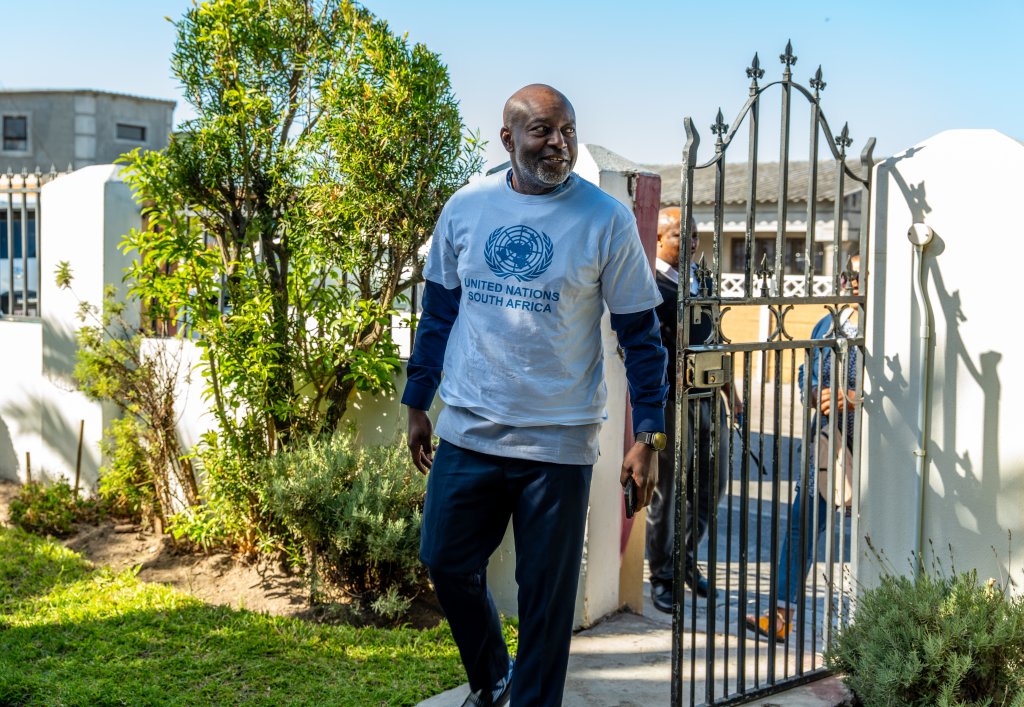
Nelson Muffuh, UN Resident Coordinator in South Africa, discusses how the UN is supporting the country in efficiently and effectively addressing the gap between policy and people.
Somewhere in South Africa today, a young graduate is sending out another job application. A small business owner is calculating the cost of unreliable municipal services. A farmer is wondering whether produce will reach a port efficiently and competitively.
None of them is waiting for another development plan. They are waiting for existing plans to have an impact.
That distinction captures one of South Africa’s defining challenges. The country is not suffering from a shortage of ideas. If anything, the opposite is true.
South Africa has a National Development Plan, a Medium-Term Development Plan, sector master plans, infrastructure programmes, industrial policies, Operation Vulindlela, the Sustainable Development Goals (SDGs) and a growing network of reforms and partnerships. Few countries have invested as much time, effort and attention in diagnosing their developmental constraints.
The destination is broadly understood: faster and more inclusive growth, substantially more jobs, functional infrastructure, capable institutions, reduced poverty and inequality, and an economy in which many more people can participate.
Recent assessments by Statistics South Africa, the National Planning Commission and the Department of Planning, Monitoring and Evaluation provide a sober account of the distance between intention and outcome. South Africa has expanded access to services and social protection, but more is needed to achieve the country’s long-term aspirations. An unemployment rate of 33.6 per cent is a national crisis. GDP growth of 1.1 per cent in 2025 was far below the level required to create jobs at scale. Uneven state capacity makes it harder to put plans into practice.
The next phase: from reform to growth
Just as importantly, however, the South Africa of today is not the South Africa of five years ago. The evidence suggests that some of the foundations for faster progress are becoming stronger.
The electricity system has become more stable. Reforms to improve the energy system and freight logistics are advancing. Public finances have reached important milestones. The Government and businesses are working more closely together, with a stronger focus on results. The country now supports 19.2 million social grant beneficiaries. The Government’s first Medium-Term Development Plan implementation assessment also reported 1.3 million children enrolled in early childhood development programmes and that 96 per cent of people living with HIV have the virus under control.
Development debates often become trapped in a false choice between pessimism and optimism. Neither creates a job, improves a classroom or restores a railway line.
The more useful question is whether institutions, investments and partnerships are delivering results at a scale and speed that can change people’s lives.
At the launch of Phase Three of the Government-Business Partnership for Growth and Jobs, President Cyril Ramaphosa described its evolution in simple but powerful terms: “Phase One was about stabilisation. Phase Two was about reform. Phase Three must be about growth.”
Those three phases may also describe South Africa’s wider development journey.
The first phase involved responding to crises that threatened the economy and public confidence. The second concentrated on reforming systems, rebuilding capacity and addressing longstanding barriers to growth. The next phase must convert that work into investment, business development and shared prosperity.
The Government-Business Partnership has set a goal of helping South Africa move towards sustained annual growth above 3 per cent and contributing to one million additional jobs by 2030. Its third phase continues to prioritise energy and logistics, while expanding its focus to mining, tourism, infrastructure, agriculture and agro-processing. It also recognises that effective local Government, creating employment for young people and tackling crime and corruption are essential to building confidence and supporting economic growth.
Those are ambitious goals. What matters now is turning them into results against clear targets. South Africa’s development gains matter, but they must be matched by an economy capable of expanding opportunities and supporting long-term progress. The gap between policy and people is where development succeeds or fails.
Cooperating for the future
Addressing that gap requires partnership, but not partnership as a slogan.
Effective cooperation must preserve the distinct responsibilities of every participant. The state must govern, regulate and deliver. Business must invest, innovate and create employment. Labour must defend decent work while contributing to productivity. Civil society must amplify community voices and demand accountability. Development partners must align support behind national priorities and avoid creating unnecessary duplication.
The United Nations is contributing to this effort through the newly signed Sustainable Development Cooperation Framework 2026-2030. Aligned with South Africa’s national priorities, the Sustainable Development Goals (SDGs) and the African Union’s Agenda 2063, the Cooperation Framework focuses the UN development system’s contribution on economic and social transformation, governance and resilience. Its value, like every development framework, will ultimately be measured outside conference rooms: in clinics, classes, farms, factories and small businesses.
These small businesses are also at the heart of the UN’s South Africa Business Initiative for Impact (SABII). At the recent Unstoppable Africa event during the UN General Assembly, SABII took centre stage for bringing together private sector, Government and development partners. The initiative links investment to the skills, markets, financing and partnerships needed for inclusive growth. It also removes obstacles to progress while bringing partners together around shared priorities. The objective is to help turn existing commitments into measurable results.
South Africa possesses many of the necessary ingredients: capable institutions, deep financial markets, a sophisticated private sector, active civil society, strong universities, considerable natural resources and immense human talent.
What matters now is whether these strengths can be combined behind a shared goal, with the urgency demanded by unemployment, poverty and inequality.
The country knows where it needs to go.
The defining question is whether delivery can finally move at the speed of ambition.
This blog was adapted from an article originally published by the UN team in South Africa. Please visit the UN team's website for more information about the UN's work in South Africa.


Latest news and updates