Critical Minerals: Turning Mineral Wealth into Jobs, Skills and Local Industry
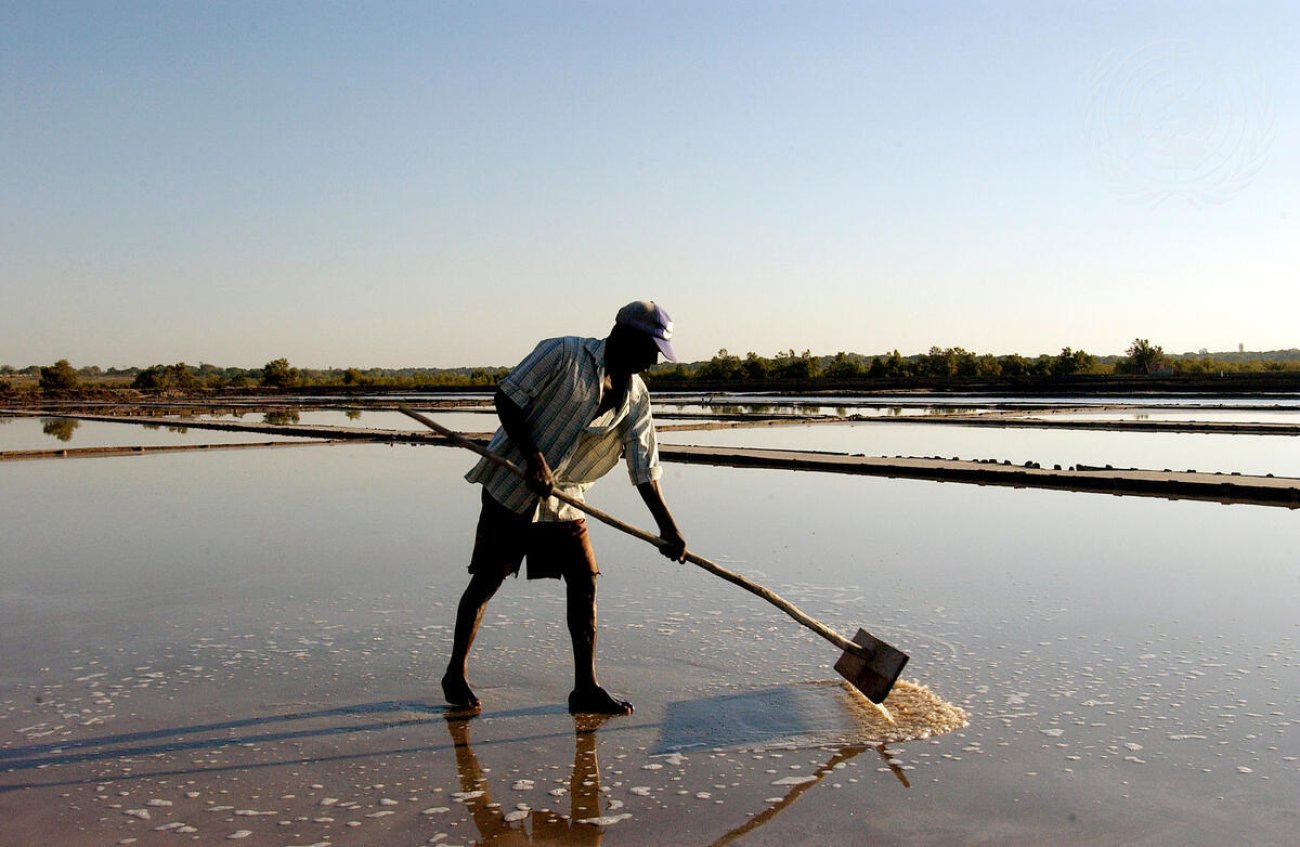
Ahead of the UN High-Level Meeting on Critical Energy Transition Minerals, Sustainable Development Officer for the Resident Coordinator System Denis Subbotnitskiy examines why fast-moving investments in processing plants must be matched by early action on skills, institutions, energy systems and community trust, so mineral wealth translates into jobs, stronger local economies, safer communities and lasting benefits for people.
Critical minerals are central to the global energy transition. But for resource-rich countries, the real challenge is no longer attracting investment — it's ensuring that mineral wealth creates local jobs, skills, industries and long-term prosperity.
That direction was set out in the report of the Secretary-General's Panel on Critical Energy Transition Minerals, Resourcing the Energy Transition, which calls for critical mineral value chains — from mining and processing to manufacturing and recycling — that generate prosperity, respect rights, protect the environment and support resource-rich developing countries.
But a new development challenge is emerging on top of that agenda: processing plants can now be built much faster than countries can localise the skills, governance systems and development benefits around them.
What happens when mineral processing outpaces local skills?
For decades, moving from extraction to processing was seen as a long industrial journey. New facilities built from scratch typically required years of feasibility studies, financing, engineering, construction and commissioning. That is changing. New project models are shortening timelines, with some companies bringing financing, technology, equipment, workers and buyers together from the start. As a result, critical minerals can now be processed much faster than many policy and planning systems expect.
Recent examples show how quickly this shift is happening. In Indonesia, a new battery-materials facility was completed in just ten months and inaugurated in August 2024. Another nickel-processing project in Sulawesi began construction in January 2025 and is expected to be ready within 18 months. In Zimbabwe, a new lithium-processing facility began operations in early 2026, with the country exporting a processed lithium product shortly afterwards.
These examples do not mean that full industrialisation can be achieved in 12 to 18 months. But they do show that critical minerals can be processed much faster than institutions, planning systems and skills are often prepared for. A plant can open in 18 months; the technicians, engineers, regulators, fiscal systems, local suppliers and community trust required to make it part of a national development strategy take much longer to build.
How can countries turn critical minerals into local jobs and growth?
That is the central development dilemma highlighted by UN Trade and Development (UNCTAD): critical minerals can create jobs, diversify economies and boost revenues, but they can also reinforce dependence on extraction and commodity exports if market forces alone shape outcomes. A processing facility may raise export value, but if the capital, technology, workforce and sales contracts remain largely external, the benefits may not reach local firms, workers or communities.
Without transparent contracts, tax capacity, safeguards to prevent profits from being shifted out of the country, local procurement strategies and clear rules for using mineral revenues, higher-value exports will not automatically translate into higher development returns.
This reinforces the need to place economic diversification at the centre of critical minerals strategies. Beyond expanding processing capacity, countries need to actively build linkages with manufacturing and services, moving towards more complex and knowledge-intensive activities. In this regard, UN Trade and Development has been supporting countries through its rapid assessment initiative on value addition and diversification in critical energy transition minerals (CETMs) value chains, which identifies concrete product-level opportunities and policy pathways to translate resource endowments into broader industrial development, job creation and economic resilience.
What countries need before processing plants open
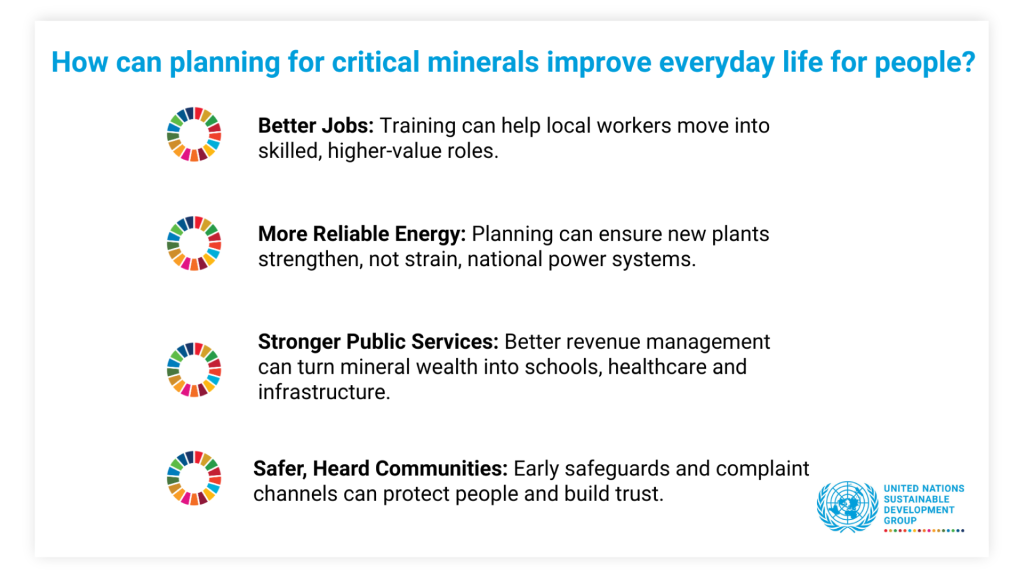
- Energy. Mineral processing needs reliable and often large amounts of electricity. If new facilities depend on weak grids, on-site fossil-fuel power, or electricity deals that do not strengthen national energy systems, they can undermine rather than support a just energy transition. Countries need to plan processing plants and energy systems together, not as separate issues.
- Skills. Labour localisation cannot be treated as an aspiration. It requires a clear pathway for national workers to move into increasingly skilled roles over time: from basic operational jobs in the early years, to technical positions over the medium term, and eventually to engineering, management and senior technical roles.
This means linking concessions and investment agreements to Technical and Vocational Education and Training (TVET), apprenticeships, university partnerships and measurable milestones. - Public finance. New mineral revenues need to be managed before they arrive. Clear fiscal rules, public investment plans, community benefit-sharing arrangements and systems to manage revenue booms and busts can help ensure that mineral wealth supports long-term development rather than short-term spending or fragmented projects.
- Community trust. Communities cannot be consulted only after decisions have already been made. Environmental safeguards, clear ways to raise concerns and local employment pathways need to be built into plans from the start.
How is the UN helping turn mineral plans into real-life benefits?
This is not only a mining policy agenda. It is a whole-of-development agenda.
The Resident Coordinator (RC) system is designed to bring UN Country Teams together in support of national priorities and implementation of the 2030 Agenda.
In critical minerals, this coordination role is especially important. Governments must act across ministries of mines, finance, energy, labour, education, environment, trade and planning. Companies bring investment and technology but are not responsible for national development strategy. Communities carry many of the local risks but often have the least bargaining power. Development partners, international financial institutions and technical agencies each bring useful tools, but not always in a coordinated sequence.
The RC and UN Country Team can offer something distinctive: neutral coordination across actors whose interests will not automatically align.
In South Africa, the Resident Coordinator and UN Country Team are accompanying the government's Just Energy Transition — connecting the Just Energy Transition Partnership and Investment Plan, TVET-based skills development, community engagement and climate financing around a single national agenda. The same convening function is now needed in critical mineral economies, where the development stakes are similarly cross-cutting.
This is also where the UN Task Force on Critical Energy Transition Minerals — launched by the Secretary-General on 10 December 2025 and co-chaired by the UN Environment Programme (UNEP), UN Development Programme (UNDP) and UNCTAD — adds value. The Task Force operates five Technical Clusters (value addition and diversification, traceability, mining legacy, artisanal and small-scale mining, and circularity) and a Country Support Mechanism being designed by UNDP in collaboration with the UN Development Coordination Office. That mechanism is the link between the Panel's global principles and on-the-ground delivery through Resident Coordinators and UN Country Teams.
Will countries be ready before the plant opens?
For resource-rich countries, the critical question is not only whether processing capacity will arrive, but whether national systems will be ready when it does.
That means preparing skills pipelines before expatriate labour locks in; planning electricity systems before processing demand strains the grid; strengthening fiscal governance before revenues peak; and engaging communities before trust is lost. It also means recognising that countries can collaborate amongst each other and that not every country needs to host every segment of the value chain.
Critical minerals can help power the global energy transition. But speed alone will not deliver that outcome.
Success should be measured not only by whether critical minerals are processed, but by whether skills, institutions, energy systems, local enterprises and community trust are ready when they are.
That is where the development test begins.





Latest news and updates