
Making Data Centres Work for Development
On UN Digital Cooperation Day, Denis Subbotnitskiy and Katarina Kuai, Sustainable Development Officers for the Resident Coordinator System, explore how countries can manage the development risks and opportunities of AI data centres as they become increasingly prominent in local communities.
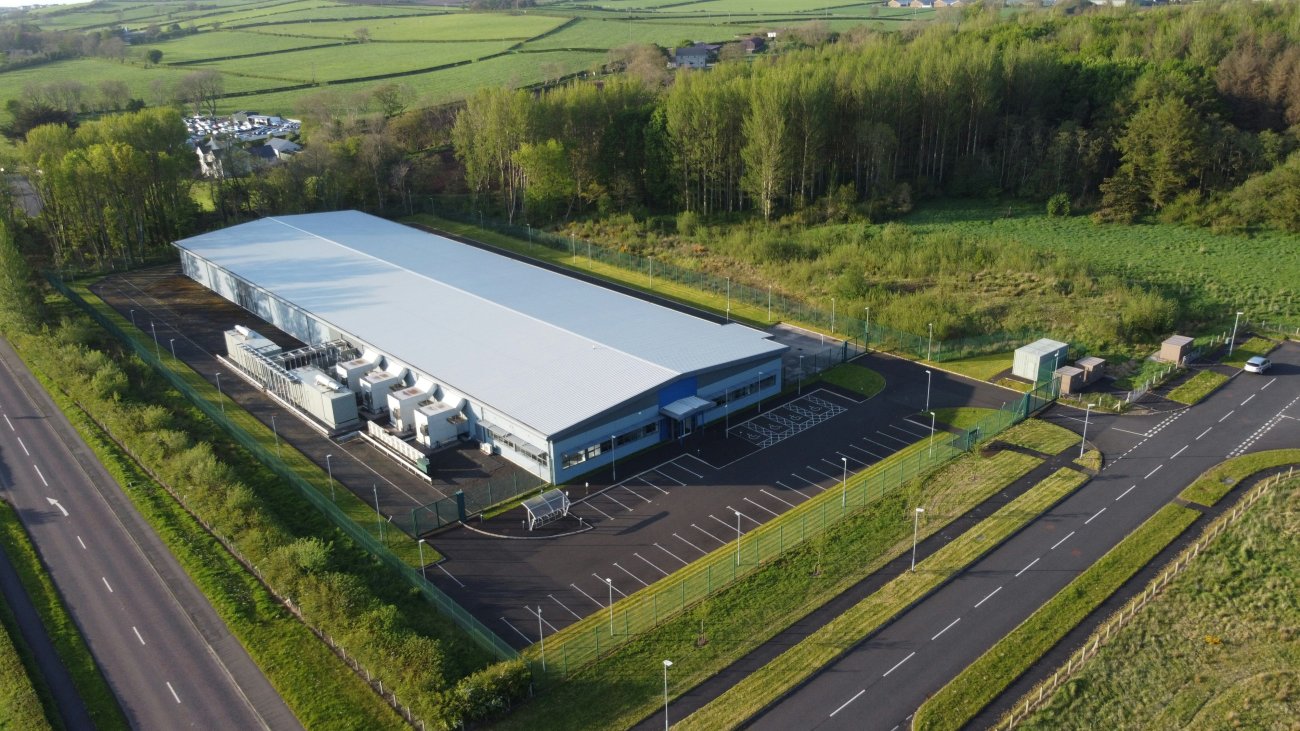
Artificial intelligence may be virtual, but the infrastructure behind it is anything but. Large data centres powering AI need land, water and a great deal of electricity delivered without interruption every hour of the day. But if data centres are not built with local development in mind, communities may miss out on their benefits and potentially pay higher electricity costs while living with fewer resources.
This is both a coordination challenge and a technical one: building a data centre touches many areas of development at once, from energy, water and the environment to finance, education and jobs. Yet mitigating these risks will require innovative solutions.
Navigating risks, optimising benefits
A data centre can be built in one to three years. But new transmission lines can take five to fifteen years, encouraging investors to build dedicated power plants that may operate separately from the national grid.
For the people living closest to a site, a data centre competes for land and, depending on how it is cooled, water – sometimes where both are already scarce. It can raise electricity costs for everyone else, if the network built to serve it is paid for by all customers, not just the data centre. And it can arrive with little consultation if negotiations only take place between national agencies and the companies that build and finance the facility.
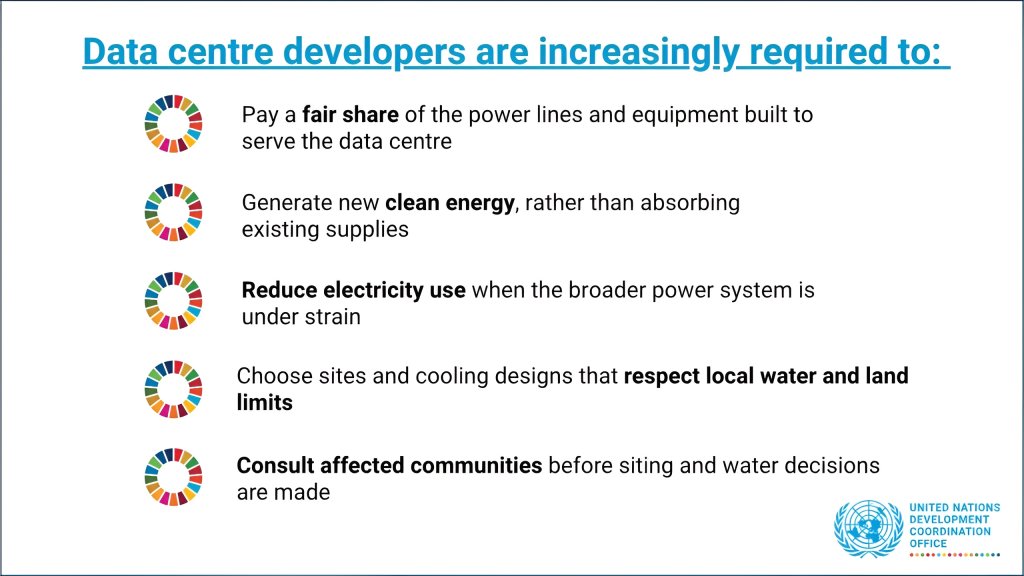
Countries can reduce these risks by writing conditions into their deals with companies rather than negotiating them afterwards. Governments can require developers to pay a fair share of the grid upgrades their facility would require, and to hire and train locally. With realistic forecasts of how much electricity the data centre will actually use, they can agree in advance that the cost of unused capacity or additional network upgrades will not fall on households and small businesses.
Handled well, the same data centre can become an anchor customer – a large, reliable buyer of electricity – whose long-term demand can help justify new power lines, storage and generation that serve everyone else as well.
Ireland, where data centres now use 23 per cent of all metered electricity, up from 5 per cent in 2015, requires new facilities to provide matching generation or storage capacity and, over time, meet at least 80 per cent of their annual electricity needs from new renewable projects built in Ireland – not from wind and solar farms that already supply everyone else. Malaysia ties investment incentives to energy and water efficiency, and steers projects away from water-scarce areas.
The principle is consistent: digital investment policy is becoming electricity policy and vice-versa.
The UN's role
The Global Digital Compact has put inclusive and sustainable digital transformation on the international agenda, including responsible use of resources across the life cycle of digital technologies. Yet as governments mark UN Digital Cooperation Day, many of the decisions shaping AI's physical footprint are made in contracts, permits and incentive packages.
Through the Resident Coordinator system, UN Country Teams bring together digital and investment authorities with government bodies responsible for energy, finance and the environment. Resident Coordinators help bring these institutions together, drawing on UN agencies’ technical expertise to shape development outcomes early.
In Lesotho, the UN is supporting the Government in convening the institutions needed to advance its National AI Strategy and Data Centre Blueprint, linking AI ambitions with infrastructure and skills planning. In August 2026, a jointly organized workshop brought together officials responsible for energy, water, environment, education, finance and trade, with support from the UN Office for Digital and Emerging Technologies and partners. Discussions concluded with work on an implementation roadmap, helping connect digital priorities with wider national development planning.

Three questions to ask before contracts are signed
What separates a project that simply consumes power from one that helps build a better electricity system? Three practical questions.
Who pays for the new energy capacity? A data centre’s customers may be anywhere in the world, but the power plant and lines built to serve it are local. Developers sometimes ask governments to guarantee that the power capacity will be paid for even if the facility uses less than planned. Such promises may not appear on government balance sheets as public debt, but if demand falls short, the resulting costs can fall on public budgets or other electricity customers. Commitments are therefore safer in stages, growing as real demand appears – and the agreement should say what happens to the power plant and the lines if the facility closes.
How will the facility fit into the electricity system? Some data centres can shift flexible workloads or use batteries to reduce grid electricity demand when the broader system is under strain. This matters for households: a large customer that draws less at peak is one reason less for the lights to go out elsewhere. The IEA estimates that 20–25 gigawatts of battery storage could be installed in data centres by 2030, potentially helping ease pressure on the grid. Governments should identify suitable zones based on available power, network capacity, fibre and water, and build realistic demand forecasts into the electricity plan.
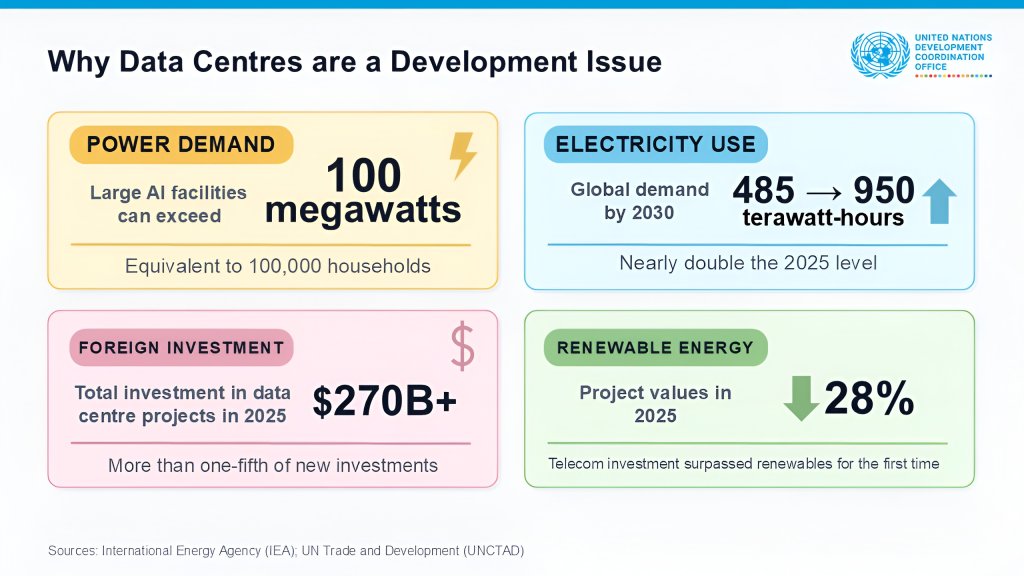
What does the investment leave behind? The test is whether the infrastructure built for the data centre – power lines, storage and generation – can serve local businesses, public services and communities. A recent UN Development Programme (UNDP) paper reveals that a typical 100-megawatt facility creates around 500 construction jobs for two or three years and a permanent workforce of roughly 50. What matters is whether it strengthens the wider economy – more reliable power, local suppliers, technical skills and computing capacity that public institutions can actually use. Data centre developers can pay to connect a pre-agreed number of households, schools and clinics in the host area to the national grid or provide computing capacity reserved for national universities and hospitals at an agreed price.
The impact of a data centre reaches far beyond the megawatts and numbers on the balance sheet. Planned as part of national energy and development systems rather than beside them, the infrastructure powering the AI economy can also help power the communities in which it is built. The 2027 high-level review of the Global Digital Compact offers an opportunity to bring these infrastructure questions into the global debate. Decisions on national contracts and connection agreements taken today will help determine whether AI investment delivers wider development benefits.





Latest news and updates